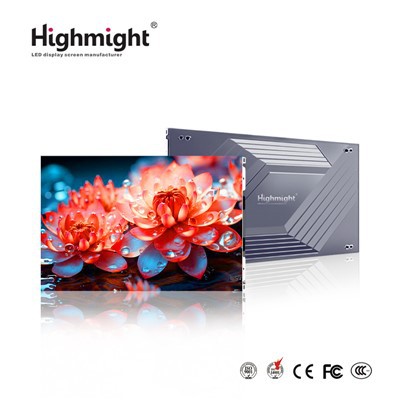

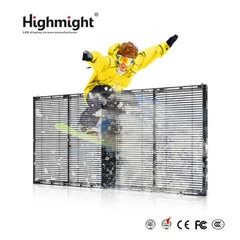


The core logic determining the clarity of an LED display is "pixel rendering accuracy + signal processing quality + environmental adaptation effect." These key factors can be categorized into three main groups, which directly or indirectly affect the fidelity and stability of image details, ultimately determining the visual experience.
Hardware core specifications
Pixel pitch (P value)
This refers to the distance between the centers of adjacent LED pixels (in millimeters), indicated as P0.9, P1.8, P2.5, etc. A smaller P value means a higher pixel density per unit area and finer detail. P0.9-P1.8 is commonly used for indoor close-range viewing, while P2.5 and above are used for outdoor long-distance viewing. The pixel pitch should be matched to the viewing distance to avoid a "grainy" appearance or wasted resolution.

Physical resolution
This refers to the number of pixels horizontally × vertically (e.g., 1080P, 4K, 8K). Higher resolution means more detail can be displayed. A 4K screen has four times the total number of pixels as a 1080P screen, allowing for clear reproduction of image textures and small text, avoiding stretching and blurring. It's important to match the display resolution with the resolution of the content being displayed; otherwise, clarity will be lost.
Pixel luminescence uniformity
This includes consistency in brightness, color, and attenuation. Large deviations will result in bright spots, dark spots, and color shifts, obscuring details. For example, some pixels being too bright can lead to overexposure in certain areas, while color shifts cause color distortion, indirectly reducing clarity.
Driver IC and scanning method
High-performance driver ICs (such as constant current ICs) determine the grayscale levels (16-bit, up to 65536 levels) and response speed (≤1ms). High grayscale levels provide rich detail in dark areas and smooth color transitions, while fast response prevents motion blur. In terms of scanning methods, high-resolution scanning such as 1/16 scan and 1/32 scan allows for more uniform pixel illumination, reducing flicker and blurring.
Signal processing technology
Signal Transmission and Decoding
Supports high-definition interfaces such as HDMI 2.1 and DP 2.0, capable of transmitting lossless 4K/8K signals, avoiding compression and loss of detail. The FPGA chip performs real-time decoding, scaling, and noise reduction, adapting to multiple device inputs and ensuring images are free from stretching and jagged edges. Frame synchronization technology prevents image misalignment during multi-screen splicing, ensuring continuity.
Grayscale and Contrast
Higher grayscale levels better reproduce light and dark details, preventing details from being "lost" in extreme brightness; higher contrast results in clearer black and white boundaries, stronger outlines for text and charts, and prevents the image from appearing "washed out."

Refresh Rate
This refers to the number of times the screen refreshes per second (typically 60Hz, 120Hz+ for high-definition screens). A higher refresh rate results in less motion blur in dynamic images (videos, scrolling text), weaker visual persistence, and higher clarity.
Environmental and Installation Considerations
1. Viewing Distance and Screen Size
The optimal viewing distance ≈ pixel pitch (mm) × 1.5. For example, the optimal viewing distance for a P2.5 screen is approximately 3.75m. Viewing a large-pitch screen from a close distance will result in a grainy image, while viewing a small-pitch screen from a far distance wastes resolution; precise matching is necessary.
2. Ambient Light Interference
Indoor screens have a brightness of 300-800 cd/㎡, while outdoor screens have a brightness of 1500-5000 cd/㎡. Inappropriate brightness will dilute the image or cause glare; an anti-glare coating on the screen surface can reduce reflections and ensure clear viewing from multiple angles.
3. Installation Accuracy
The splicing gap of spliced screens should be ≤0.5mm (seamless screens ≤0.1mm); a gap that is too wide will disrupt the image. The installation flatness deviation should be ≤1mm/㎡; protrusions or depressions will lead to uneven light refraction, causing localized blurring.
In summary, the clarity of an LED screen is a comprehensive result of "small pixel pitch + high resolution + strong driving capability + environmental adaptation." When selecting a screen, first determine the viewing distance and scenario, then prioritize matching the pixel pitch and resolution, supplemented by signal processing and installation optimization, to achieve optimal clarity.