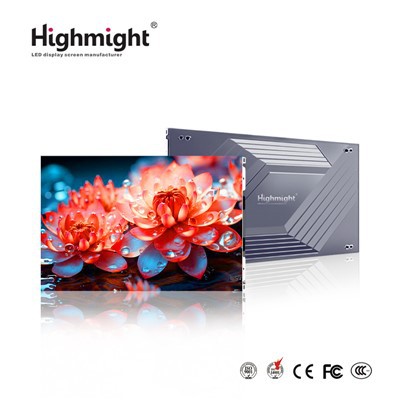



With the rapid iteration and continuous expansion of market share of Mini & Micro LED technologies, the choice of packaging method has become a core variable determining product performance, cost, and applicable scenarios. Among these, the competition between COB and MIP technologies is particularly fierce, while SMD and GOB methods have also secured specific market positions with their unique advantages. A deep understanding of the differences between these four packaging technologies is not only crucial for grasping display industry trends but also a prerequisite for companies to match their specific application scenarios.
SMD: The "cornerstone" of traditional packaging, but the limitations behind its maturity
As a traditional packaging technology in the LED display field, the core logic of SMD (Surface Mount Device) is "package first, then mount": red, green and blue light-emitting chips are packaged into independent lamp beads, and then soldered to the PCB board with solder paste through SMT (Surface Mount Technology). After being assembled into unit modules, they are spliced into a complete display screen.
The advantages of SMD technology lie in its mature industry chain and standardized processes, which initially dominated the field of small-pitch displays (such as P2.0 and above). However, as the pitch shrinks to below P1.0, its shortcomings have gradually become apparent: the packaging cost of a single LED chip increases with the size reduction, and the gap between LED chips easily leads to "uneven black areas on the screen," resulting in noticeable graininess when viewed up close, making it difficult to meet the pursuit of "ultimate picture quality" in Mini & Micro LED.

COB: The "main player" in micro-pitch displays, with a performance leap from formal to inverted displays.
COB (Chip on Board) breaks the traditional logic of "packaging first and then mounting," directly soldering multiple RGB chips onto the same PCB board, then completing the encapsulation through integrated film coating, and finally assembling them into a unit module. As the core route in the current Mini & Micro LED micro-pitch field, COB is further divided into "convertible" and "flip-chip" types, with a clear direction for technological iteration.
Formal COB: Performance limitations of the basic model
Formal COB requires connecting the chip to the PCB board via gold wires. Due to the physical characteristic that "the light emission angle depends on the wire bonding distance", it is difficult to improve its brightness uniformity, heat dissipation efficiency and reliability. Especially in ultra-fine pitch scenarios below P1.0, the precision requirements of the wire bonding process are greatly increased, and the yield and cost control are more difficult. It is gradually being replaced by flip-chip COB.
Inverted COB: The full advantages of an upgraded version
Flip-chip COB eliminates gold wires, directly connecting the chip to the PCB via electrodes on the bottom, achieving a multi-dimensional performance leap:
· Superior Image Quality: Without gold wire obstruction, luminous efficiency is improved, enabling true "chip-level pitch" (e.g., P0.4-P1.0), resulting in a grain-free viewing experience up close, and significantly superior black consistency and contrast compared to traditional SMD.
· Enhanced Reliability: Reduced soldering nodes and shorter heat dissipation paths improve long-term stability, and the film-coated encapsulation provides dust and moisture protection.
· More Competitive Cost: As the technology matures, COB costs continue to decrease. According to industry experts, in P1.2 pitch products, COB prices are already lower than comparable SMD products, and the smaller the pitch (e.g., P0.9 and below), the more pronounced the cost advantage of COB.
However, COB also presents unique challenges: Unlike SMD, it cannot optically sort individual LEDs, requiring point-by-point calibration of the entire screen before shipment, increasing calibration costs and process complexity.

MIP: The innovative approach of "breaking down the whole into parts" to balance performance and mass production efficiency
MIP (Mini/Micro LED in Package) is based on "modular packaging," which involves cutting the light-emitting chips on an LED panel into "single devices or multi-unit devices" according to specific specifications. First, units with consistent optical performance are selected through light separation and mixing. Then, they are assembled into modules by surface mount technology (SMT) soldering onto a PCB board.
This "divide and conquer" approach gives MIP three core advantages:
· Superior Consistency: By classifying devices of the same optical grade through full pixel testing (mixed BIM), color consistency reaches cinema-grade standards (DCI-P3 color gamut ≥99%), and defective devices can be directly rejected during sorting, resulting in high final assembly yield and significantly reduced rework costs;
· Enhanced Compatibility: Adaptable to different substrates such as PCBs and glass, covering pitches from P0.4 ultra-fine to P2.0 standard, accommodating both small-to-medium-sized (e.g., wearable devices) and large-sized (e.g., home TVs, cinema screens) Micro LED applications;
· High Mass Production Potential: Modular packaging simplifies the complexity of mass transfer, resulting in lower losses and potentially further reducing unit costs, improving mass production efficiency, and solving the core pain point of "difficult mass production" for Micro LED.

GOB: "Protection + Image Quality" Dual Upgrade, Adapting to Special Scene Requirements
GOB (Glue on Board) is not an independent chip packaging technology, but rather an addition of a "light surface potting" process to SMD or COB modules. This involves covering the screen surface with a frosted adhesive layer, providing a scenario-specific solution for "high protection and low visual fatigue."
Its core advantages lie in enhanced protection performance and improved visual experience:
· Ultra-high protection: The adhesive layer provides waterproofing, moisture resistance, impact resistance, dust resistance, corrosion resistance, anti-static properties, and blue light protection, making it suitable for outdoor advertising, humid environments (such as near swimming pools), industrial control, and other special scenarios;
· Image quality adaptation: The frosted adhesive layer transforms "point light sources" into "area light sources," expanding the viewing angle, effectively eliminating moiré patterns (such as screen reflections in security monitoring scenarios), reducing visual fatigue during prolonged viewing, and improving image detail.
However, the GOB potting process increases costs, and the adhesive layer may slightly affect brightness, making it more suitable for scenarios with strong requirements for "protection" and "visual comfort," rather than a general-purpose display solution.
V. Technology Choices: Differentiation, Not Substitution – Lanpu Vision's All-Scenario Empowerment
From the "maturity and stability" of SMD, to the "mainstay of micro-pitch" of COB, to the "mass production innovation" of MIP and the "scenario adaptation" of GOB, these four packaging technologies are not mutually exclusive replacements, but rather differentiated choices for different needs:
· For low-cost, standardized conventional small-pitch scenarios (such as commercial advertising above P2.0), SMD still offers cost-effectiveness;
· For focusing on ultra-micro-pitch and ultimate image quality (such as command centers, home theaters, and virtual shooting), flip-chip COB is currently the preferred choice;
· For deploying Micro LED mass production and multi-size compatibility (such as automotive displays and wearable devices), the potential of MIP is more promising;
· For special protection requirements (such as outdoor and industrial environments), the customization advantages of GOB become prominent.
As a technology pioneer in the LED display field, Lanpu Vision has built a full-series product matrix covering SMD, COB, MIP, and GOB. Leveraging numerous international and domestic patented technologies and extensive experience in small-pitch projects, it provides precise solutions for various scenarios. Its products are widely used in command centers, security monitoring, commercial advertising, sports, home theaters, virtual photography, and other fields, truly achieving "adapting technology to needs and empowering scenarios with products."
With the continuous breakthroughs and cost reductions in Mini & Micro LED technology, the competition in packaging routes will shift from "single performance comparison" to "scenario-based adaptation capabilities." In the future, the competition between COB and MIP will drive continuous technological iteration, while SMD and GOB will continue to play a valuable role in specific areas, jointly helping Mini & Micro LED penetrate more consumer and industrial scenarios, opening up new growth opportunities for the display industry.