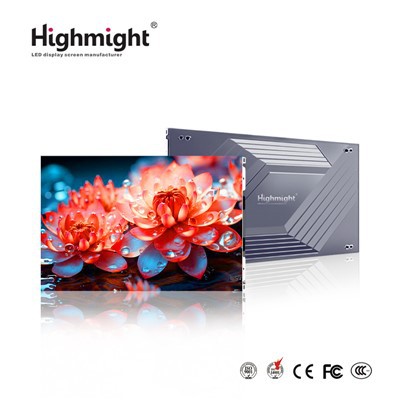



COB (Chip on Board) and SMD (Surface Mounted Device) are two mainstream packaging technologies for LED displays, each with its own advantages and disadvantages, suitable for different scenarios. The following is a detailed comparison:
1. COB (Chip on Board) technology
Advantages:
High reliability
The LED chip is directly packaged on the PCB board, without bracket welding, strong vibration and impact resistance, suitable for harsh environments (such as outdoor, traffic, etc.).
Better heat dissipation performance
The chip is directly in contact with the PCB, the heat dissipation path is short, reducing the risk of overheating and extending the life.
Higher protection
The surface is covered with epoxy resin or silicone, which is dust-proof, moisture-proof and corrosion-resistant (high IP level), suitable for high humidity or dusty environments.
Smaller pixel pitch
Micro pitch (below P0.5) can be achieved, suitable for high-definition display for close viewing (such as conference rooms, control rooms).
No solder joint detachment problem
The solder joints of traditional SMD are prone to failure, while the COB packaging structure is more stable.
Disadvantages:
Higher cost
The production process is complex, the yield rate is low, and the initial investment and maintenance costs are high.
Difficult to repair
If a single LED is damaged, the entire module needs to be replaced, and the repair cost is high.
Low brightness
Due to the light transmittance limit of the packaging material, the brightness is usually not as good as SMD, and outdoor high-brightness scenes may be limited.
High surface flatness requirements
Special processes are required to ensure display consistency, otherwise brightness/color difference problems may occur.
2. SMD (Surface Mounted Device) technology
Advantages:
Mature and low cost
The technology is mature, the industrial chain is complete, the production cost is low, and it is suitable for large-scale applications (such as advertising screens and stage screens).
High brightness
High brightness (7000-10000nit) can be achieved through high-power LEDs, which is suitable for outdoor direct sunlight environments.
Easy to repair
If a single LED is damaged, it can be replaced separately, and the repair cost is low.
Good color consistency
The spectrophotometry and color separation process is mature, and the color difference is easy to control.
Disadvantages:
Low reliability
The solder joints are easily affected by vibration and temperature difference, resulting in false soldering or falling off, and the failure rate is high.
Poor protection
Exposed solder joints and brackets are susceptible to dust and moisture corrosion (IP rating is usually low).
Heat dissipation problem
Depending on PCB heat dissipation, long-term high-brightness operation may affect life.
Limited pixel spacing
Micro-pitch (below P1.0) is difficult to achieve, and close viewing may have a grainy feel.
3. Application scenario comparison
| Technology | Applicable scenarios | Not applicable scenarios |
| COB | Indoor high-definition screen (conference room, cinema), medical screen, control room, | High brightness outdoor screen, low-cost project |
| SMD | Outdoor advertising screen, stage rental screen, conventional commercial display | Micro pitch screen, high protection demand environment |
4. Summary
Choose COB: pursue high reliability, micro-pitch, long life, and sufficient budget.
Choose SMD: need high brightness, low cost, convenient maintenance, suitable for conventional applications.
With the improvement of COB process and the reduction of cost, the share of high-end market may further increase in the future, but SMD will still dominate the mid- and low-end market with its maturity.